
AI website builders can generate a functional page in under 60 seconds. That is not a marketing claim. It is true. The technology works, the market is real, and the appeal is obvious: why spend thousands on a professional when a tool can do it for the price of a coffee subscription?
The answer is in the data. And the data does not support the narrative you have been sold.
The $6.3 billion question
What AI builders promise
The pitch is compelling. Tools like Wix ADI, Framer AI, Durable, 10Web, and a growing list of competitors promise a complete website in minutes. No coding. No design skills. No agency fees. Just describe your business, pick a style, and publish. If you are comparing those tools head to head, we ranked the best AI builder in every category for 2026 in a data-heavy follow-up to this article.
For certain use cases, this works. A personal blog. A simple portfolio. A placeholder page while you figure out your real strategy. If the stakes are low and the requirements are basic, AI builders deliver genuine value.
The problem starts when businesses treat these tools as a substitute for professional development. And that is exactly what the marketing encourages.
What the data shows
According to industry research from Pertama Partners, 80.3% of AI projects fail to deliver business value. That breaks down to 33.8% abandoned before production, 28.4% completed but delivering no measurable value, and 18.1% unable to justify their costs. Gartner adds that 95% of generative AI pilots fail to scale beyond initial deployment.
The AI website builder market is projected to reach $6.3 billion by 2026. That number proves demand, not quality. People want faster, cheaper websites. The question is whether faster and cheaper produces results that justify the investment, even when the investment is small.
The evidence says no. Not for businesses that depend on their websites to attract customers, build trust, and generate revenue.
SEO: the invisible penalty
A website nobody can find is a website that does not exist. This is where AI builders create the most damage, and where the damage is hardest to see.
Content quality signals
In 2025, Google updated its Quality Rater Guidelines to specifically target low-effort AI content. Quality raters now mark mass-produced pages with no original insight as "Lowest" quality, regardless of how they were generated. AI-built websites that publish template content with minor keyword swaps are exactly the type of content this update was designed to penalize.
The issue is not that AI writes poorly. It writes fluently. The issue is that fluent, generic content does not rank. Google rewards depth, originality, and demonstrated expertise. An AI builder generating boilerplate "About Us" and "Services" pages cannot demonstrate any of those things.
This extends beyond traditional search. AI-powered search engines like ChatGPT and Perplexity prioritize authoritative, well-structured content when deciding which businesses to recommend. A site built from templates with thin content is invisible to both Google and AI search.
The 2026 search market made this worse
Since this article was first published, the math has moved further against template-thin sites. Google ran a confirmed spam update and core update in late March 2026, both reinforcing its scaled-content-abuse policy. SEO analysts reported that sites publishing large volumes of unedited AI pages lost substantial organic traffic, while sites using AI as a drafting tool under human editing held steady or grew. The update did not penalize AI for being AI. It penalized exactly what AI builders produce by default: fluent, generic pages with no original expertise, no unique perspective, and nothing a reader cannot already find in the top results.
The bigger shift is where attention now goes. In the first four months of 2026, 68% of US Google searches ended without a single click, according to SparkToro's analysis of Similarweb clickstream data. AI Overviews now appear on more than 20% of searches and, per the same study, cut click-through rates by nearly 60% when they show. Google's fully generative AI Mode passed 1 billion monthly users by its I/O 2026 announcement, with query volume more than doubling each quarter. In that environment, only authoritative, well-structured content earns a citation in the answer box. A site assembled from boilerplate does not get summarized, recommended, or clicked. It simply disappears, and the owner often never sees the traffic that never arrived.
Technical SEO gaps
Content is only half the equation. AI builders consistently fall short on technical SEO fundamentals:
- Bloated HTML and JavaScript. Template-heavy platforms ship render-blocking code that inflates page weight and slows load times.
- Limited schema markup. Most builders offer basic schemas at best. Custom structured data for FAQs, products, reviews, and local business are either unavailable or require workarounds.
- Poor URL structures. Auto-generated URLs with random parameters, no control over slugs, and limited redirect management.
- No hreflang support. For businesses targeting multiple languages or regions, this is a dealbreaker. Platforms like WordPress handle this natively.
- Limited canonical and crawl control. Duplicate content issues, poor sitemap generation, and no ability to manage crawl budgets.
Performance and Core Web Vitals
Google uses Core Web Vitals as a direct ranking signal. Three metrics matter: Largest Contentful Paint (LCP), Cumulative Layout Shift (CLS), and Interaction to Next Paint (INP). AI builders struggle with all three.
LCP above 4 seconds is common on AI-built sites. Google considers anything above 2.5 seconds "needs improvement" and above 4 seconds "poor." When your LCP is poor, you are actively losing ranking positions to competitors with faster sites.
The root cause is architectural. AI builders load heavy JavaScript frameworks, unoptimized images, and third-party scripts by default. A professional developer chooses lightweight frameworks, implements lazy loading, defers non-critical scripts, and optimizes assets for each device. We documented this process in detail when we optimized a 520KB Three.js WebGL background to score 100 on mobile PageSpeed.
The difference is not marginal. It is the difference between a site that ranks and converts and a site that loads slowly and loses visitors before they see your first heading.
Security: the silent risk
As we covered in our analysis of AI in web development, 45% of AI-generated code contains security vulnerabilities classified within the OWASP Top 10. XSS vulnerabilities are 2.74x more frequent in AI output. Misconfigurations are 75% more common.
AI website builders add a layer of risk that most business owners never consider. The code powering your site is generated by AI, but you have no visibility into that code. You cannot audit it, you cannot patch it, and you cannot control it. When a vulnerability is discovered in the platform, you are dependent on the vendor to fix it. If your business collects customer data, processes payments, or operates in a regulated industry, this is not an acceptable risk profile.
A professionally built site includes security by design: input validation, CSRF protection, content security policies, secure authentication, and regular dependency audits. These are not optional features. They are engineering fundamentals that AI builders routinely skip.
Design, conversion, and brand
The template ceiling
AI builders start from templates. Even the most sophisticated ones generate variations of the same layouts, the same component patterns, and the same visual language. The result is a website that looks like every other website built on the same platform.
For a business competing in a crowded market, looking generic is expensive. Your website is often the first impression a potential customer has of your brand. If it looks like a template, it communicates that your business operates at the template level. Brand perception is a business asset, and template websites erode it.
Custom design is not about aesthetics for the sake of aesthetics. It is about building a visual identity that communicates your positioning, your values, and your price point. A luxury brand cannot look like a startup landing page. A B2B consultancy cannot look like an e-commerce template. The design must match the business.
The conversion rate gap
Custom-designed websites deliver 2-3x higher conversion rates than template-based alternatives. A well-executed custom redesign typically produces a 20-50% conversion lift within six months, with payback periods of 4-14 months depending on traffic and deal value.
The reason is not mysterious. Custom design optimizes every element for your specific audience: the placement of CTAs, the information hierarchy, the trust signals, the form structure, the page flow. An AI builder optimizes for the average case. Your business is not the average case.
The true cost of free
Hidden costs breakdown
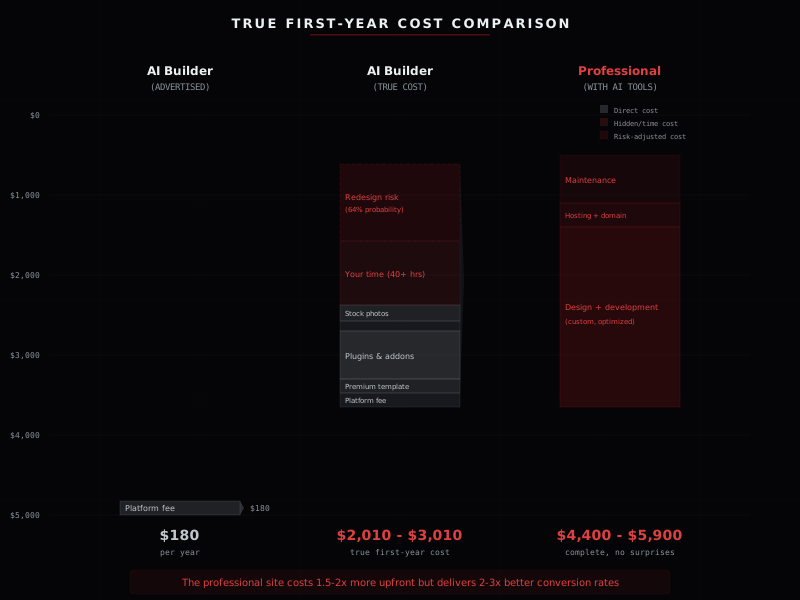
The advertised monthly price of an AI builder represents only 20-40% of true first-year costs. This is the number that catches most business owners off guard.
A "free" or $15/month platform quickly accumulates real expenses:
- Premium templates: $50-200 because the free ones look like free ones.
- Third-party plugins: $10-50/month each for forms, booking, analytics, chat, or CRM integration that the builder does not include.
- Stock photography: $100-500 because AI-generated images have their own quality ceiling.
- Domain and professional email: $50-150/year, often not included in the builder plan.
- Your time: 40+ hours learning the platform, designing layouts, writing copy, troubleshooting issues. If your time has business value, this is the largest hidden cost.
Conservative total for the first year: $1,500-3,000. And that is before the redesign.
The redesign tax
64% of AI-built websites require a complete redesign within 12 months. The site that was "good enough" at launch does not perform in search, does not convert visitors, and does not scale with the business. The redesign costs more than building it correctly would have cost in the first place.
If you are comparing quotes from web agencies, factor in the total cost of ownership, not just the sticker price. A $5,000 professional site that lasts three years costs less per month than a $180/year builder that needs replacing after one.
Do
- ✓ Calculate total first-year cost including plugins, hosting, and premium features
- ✓ Factor in the cost of your own time spent building and maintaining the site
- ✓ Compare the investment against expected revenue the site should generate
- ✓ Ask agencies for phased pricing if your budget is limited
Don't
- ✗ Compare a $0/month builder price to a $5,000 professional quote at face value
- ✗ Ignore the redesign cost that follows 64% of AI-built sites within 12 months
- ✗ Assume "free" means zero financial risk to your business
- ✗ Treat your website budget as an expense instead of an investment
Want to know what a professional website actually costs?
Our interactive quote generator gives you a realistic scope and budget in under 3 minutes. No sales calls. No pressure.
Accessibility and legal compliance
The European Accessibility Act takes full effect in June 2025, requiring websites of businesses selling products or services in the EU to meet WCAG accessibility standards. Non-compliance carries financial penalties and, more importantly, excludes users with disabilities from accessing your business.
AI builders do not reliably produce accessible websites. Common failures include missing alt text on images, poor color contrast ratios, broken keyboard navigation, missing ARIA labels, and forms without proper label associations. Some platforms are beginning to address these gaps with automated scanning tools, but automated scanning catches only about 30% of accessibility issues. The rest requires manual review by someone who understands WCAG guidelines.
A professionally built website includes accessibility as a design requirement from day one, not as an afterthought patched by an automated scanner.
Where AI actually works
This is not an anti-AI argument. We use AI every day. It is the most powerful productivity tool our industry has ever seen. The distinction is in how it is used.
AI as accelerator, not architect
81% of developers report increased productivity when using AI tools in their workflows. That statistic is real and significant. But notice the phrasing: in their workflows. The AI is a tool within a professional process, not a replacement for the process itself.
An AI website builder removes the human from the process. A professional who uses AI keeps the human in control and uses AI to move faster. The difference in outcomes is enormous.
What supervised AI delivers
At APEX DIGITAL, AI accelerates every phase of development:
- Rapid prototyping. Clients see a working concept within days, not weeks. Feedback cycles shorten. Direction is locked before significant development investment.
- Code generation under review. AI writes first drafts of components, functions, and configurations. Every line is reviewed, tested, and secured by an engineer.
- Content optimization. AI assists with keyword research, content structure, and meta descriptions. The SEO strategy, editorial judgment, and brand voice come from humans.
- Testing and QA. AI generates test cases, identifies edge cases, and speeds up quality assurance. It catches what we might miss. We catch what it cannot understand.
- Performance tuning. AI identifies bottlenecks and suggests optimizations. The architect decides which optimizations make sense for the specific project.
The result: development that is faster than traditional methods but maintains the quality, security, and strategic depth that only human expertise provides. This is the model that works. This is how modern platforms like WordPress and frameworks like Astro, Webflow, and Framer are best used.
Do
- ✓ Use AI to accelerate your project timeline with a professional guiding the process
- ✓ Hire a developer or agency that openly uses AI tools under expert supervision
- ✓ Invest in custom design, proper SEO, and performance optimization from day one
- ✓ Request a scope that includes security, accessibility, and post-launch support
Don't
- ✗ Build your business website entirely with an AI builder and no professional review
- ✗ Skip security audits because the AI "handled it"
- ✗ Publish AI-generated content without human editing and fact-checking
- ✗ Sacrifice SEO, performance, or accessibility to save on upfront cost
The smart path forward
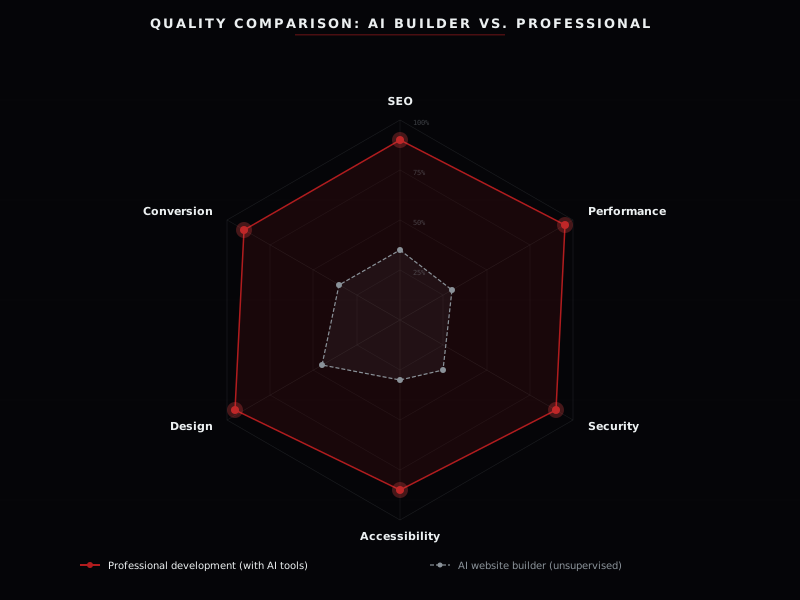
The choice is not "AI or no AI." That framing is outdated. Every serious web agency uses AI in 2026. The choice is between unsupervised AI (you and a builder, alone) and supervised AI (a professional team using AI tools to deliver better results, faster).
Unsupervised AI gives you speed and low upfront cost. It takes away SEO performance, security, conversion optimization, brand differentiation, scalability, and long-term cost efficiency.
Supervised AI gives you speed and quality. It costs more upfront. It costs less over three years. It generates more revenue. It protects your brand. It ranks. It converts. It scales.
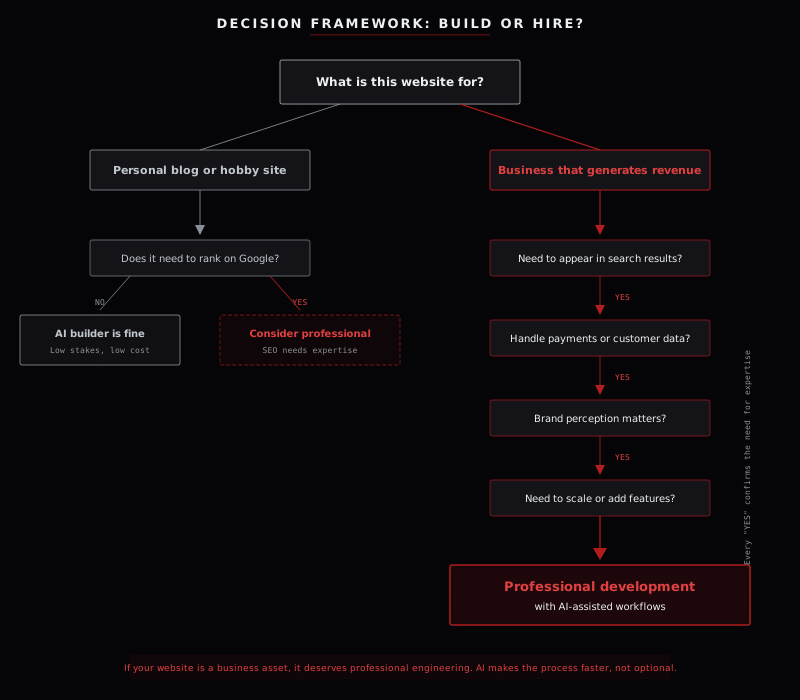
If your website is a business card you hand out at events, an AI builder might be enough. If your website is a business asset that generates leads, builds trust, and drives revenue, it deserves the same level of investment you would give any other revenue-generating asset. Once the site is built to convert, the other half of the equation is paid traffic. Our Google Ads management service handles that side.
Frequently asked questions
Can I build a professional website with AI in 2026?
You can build a functional website, but "functional" and "professional" are different standards. AI builders produce sites that look acceptable at first glance but consistently underperform in SEO, Core Web Vitals, security, and conversion rates. 64% of AI-built websites require a full redesign within 12 months. For a business that depends on its website to generate revenue, professional development with AI-assisted workflows delivers measurably better results.
Are AI website builders bad for SEO?
AI builders create structural SEO problems that are difficult to fix after launch. Common issues include bloated code that slows page load times (LCP above 4 seconds triggers Google ranking penalties), duplicate or thin content that Google classifies as "Lowest" quality, missing semantic HTML, and limited control over technical SEO elements like canonical tags, schema markup, and crawl directives. A professionally built site with proper technical SEO consistently outranks AI-generated pages.
How much does an AI website builder actually cost?
The advertised price represents only 20-40% of true first-year costs. A free or $15/month builder typically requires premium templates ($50-200), third-party plugins ($10-50/month each), stock photography, domain and email hosting, and eventually professional help to fix SEO and performance issues. Total first-year costs regularly reach $1,500-3,000 for a site that still underperforms a professionally built alternative.
What is the difference between an AI website builder and a developer who uses AI?
An AI website builder replaces the human entirely: you describe what you want, the AI generates the site, and you publish it. A developer who uses AI treats it as a productivity tool under expert supervision: AI generates code drafts, the developer reviews, optimizes, secures, and architects the final product. The first approach has an 80% failure rate. The second delivers the same quality as traditional development in significantly less time.
Is it worth hiring a web developer when AI can build sites for free?
Yes. Custom-designed websites deliver 2-3x higher conversion rates than template-based alternatives. A $5,000 professional site that converts 3% of visitors generates far more revenue than a free AI site that converts 0.5%. The cost of a professional website is an investment with measurable ROI. The cost of a failed AI site includes lost revenue, damaged brand perception, and the eventual expense of rebuilding correctly.
Will AI website builders replace web developers?
No. The $6.3 billion AI builder market proves demand exists, but 80.3% of AI projects fail to deliver business value, and 95% of generative AI pilots fail to scale. AI makes developers faster and more productive (81% report increased productivity), but it does not replace the architecture, security, performance optimization, and business strategy that professionals provide. The future is AI-assisted professional development, not AI-replaced development.
Ready for a website that works as hard as you do?
We build websites, e-commerce stores, and custom web applications. AI makes us faster. Expertise makes the difference.