
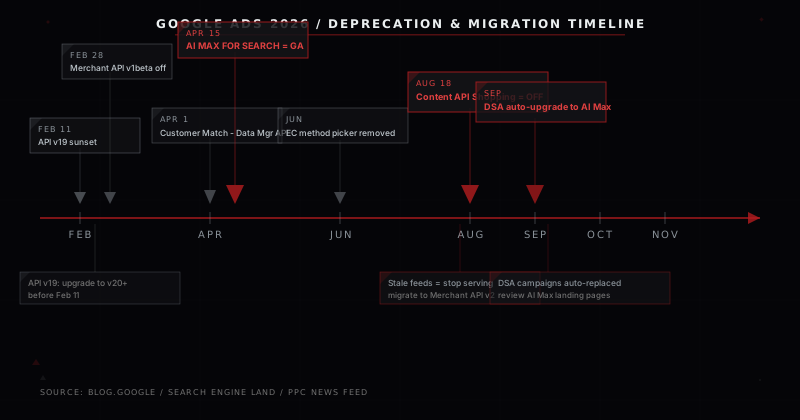
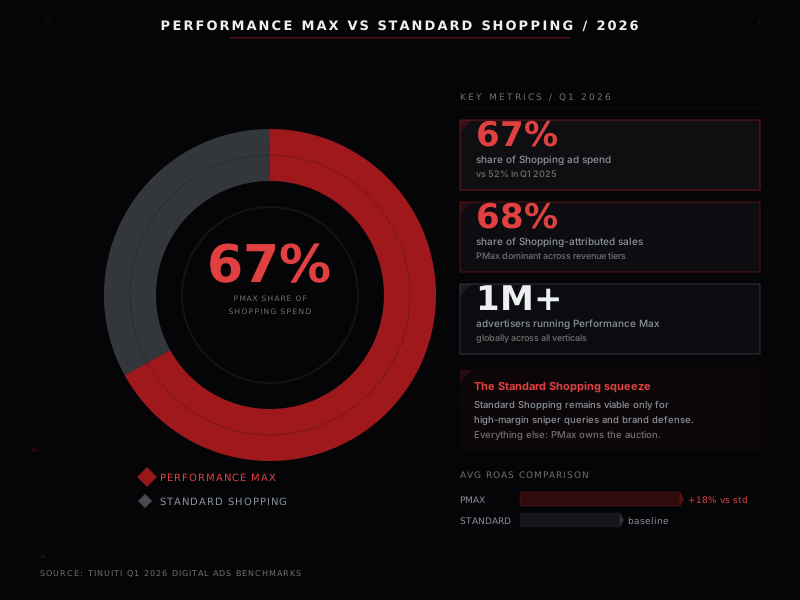
2026 is the year Google Ads stopped being a keyword auction and started being a measurement, feed, and identity system with an auction attached. AI Max for Search went generally available on April 15. Dynamic Search Ads are being auto-upgraded out of existence in September. The Content API for Shopping stops functioning on August 18. Performance Max is now used by more than a million advertisers and accounts for two thirds of Shopping spend.
For e-commerce, that compresses the margin for error. The accounts that still treat Google Ads like a 2019 keyword game are quietly losing impression share to competitors with cleaner feeds, tighter conversion tracking, and Smart Bidding strategies that actually have the data they need to make decisions.
APEX DIGITAL has run Google Ads for online stores since 2015. Over a decade on the platform, more than EUR 100 million in client revenue moved through Google and TikTok Ads, and Google Partner status held continuously since 2020. We have rebuilt accounts that were burning money and shipped accounts that paid for themselves inside the first month, including Marché CTFO, a grocery e-commerce store we scaled past $1 million in tracked revenue. This is not a vendor pitch. It is the playbook we run on every audit, written down so an in-house operator can run the same checks before we even pick up the phone.

What changed in Google Ads in 2026
The most visible change is AI Max for Search. Google announced general availability on April 15, 2026 after eleven months of open beta. AI Max is the consolidation of three previously separate machine-learning features into a single switch on Search campaigns: search-term matching that goes beyond keyword match types, AI-generated text customization that adapts headlines and descriptions to the query, and final URL expansion that routes the click to the most relevant landing page. Google reports an average lift of 14 percent in conversions or conversion value at similar CPA or ROAS, and 27 percent for accounts previously running exact and phrase match only.
The flip side: Dynamic Search Ads are being upgraded to AI Max and retired. Manual upgrade prompts appeared in the Google Ads UI in April. Automatic upgrades begin in September 2026 and complete by the end of that month, after which new DSA campaigns can no longer be created in the UI, Editor, or API. Search Engine Land has a clear breakdown of the retirement timeline.
Performance Max picked up nine major changes in 2026 that anyone running e-commerce should know about. Google rolled out channel-level performance reporting across Search, YouTube, Discover, Gmail, Display, Search partners, and Maps. Search-terms reporting inside PMax now matches Standard Shopping granularity. The negative keyword limit jumped from 100 to 10,000 per campaign, with account-level negative keyword lists supporting up to 5,000 entries. Brand exclusions at the campaign level are stable. Customer-list exclusions arrived so you can stop spending against existing converters when the goal is acquisition. The asset-group video limit was raised to 15 videos per asset group, and Campaign Total Budgets now allow fixed total spend across three to ninety day windows, which finally makes flash sales and seasonal bursts straightforward to plan. Gemini models are powering creative asset generation, audience identification, and budget allocation inside PMax, with Google's own announcement detailing the rollout.
Demand Gen shipped monthly product drops in 2026. The April drop added view-through conversion optimization for YouTube and expanded Demand Gen into Google's Commerce Media Suite, which feeds retailer first-party catalog and conversion data into Demand Gen across YouTube, Discover, and Gmail. The January drop launched Shoppable CTV powered by Demand Gen, where campaigns including TV-screen inventory drove an average seven percent more conversions at the same return on investment. Creator partnerships on YouTube Shorts via Demand Gen produced a 30 percent conversion lift at the same CPA in case studies Google shared.
Merchant Center Next is the part of the migration that has caught the most e-commerce operators off guard. The Merchant API is now generally available and is the primary product and business-data layer, replacing the Content API for Shopping. The hard cut-off is August 18, 2026. After that date, products pushed via Content API stop serving. Stores using Google Sheets feeds, scheduled fetches, or manual uploads are unaffected. Stores using third-party feed tools should confirm their tool has migrated to the Merchant API. Google's own developer changelog tracks the timeline.
A few smaller changes round out the year. Call-only ad creation ends in February 2026, with serving stopping in February 2027. The Google Ads API v19 was sunset on February 11, 2026, so anything touching the API needs to be on v20 or later. The Privacy Sandbox push is largely over: Google ended the forced third-party cookie deprecation in mid-2024 and retired most Privacy Sandbox APIs in October 2025, which means first-party data, Enhanced Conversions, and Consent Mode v2 are no longer optional add-ons. They are the foundation everything else depends on.
Performance Max vs Standard Shopping in 2026
The 2018-to-2024 narrative was that Performance Max would replace Standard Shopping. In 2026 that narrative is dead. Tinuiti's Q1 2026 Digital Ads Benchmark Report shows that Performance Max accounts for 67 percent of Shopping spend and 68 percent of Shopping-attributed sales among advertisers running both PMax and Standard Shopping side by side. The two campaign types coexist on most healthy accounts, and the consensus across independent agencies has shifted from "PMax replaces Standard Shopping" to a clear hybrid model.
The clean way to think about it: Performance Max is for scale, Standard Shopping is for control. PMax is a shotgun across Search, Shopping, YouTube, Discover, Gmail, Display, and Maps. Its strength is signal aggregation. Its weakness is that you cannot easily steer where the inventory goes. Standard Shopping is a sniper rifle. Its strength is that you can stack priority settings, layer high-bid generic queries, and use granular negative keywords to redirect specific search terms into specific campaigns.
The hybrid model in practice: PMax handles the long tail and the upper funnel where you cannot economically maintain manual control. Standard Shopping covers margin-sensitive SKUs, seasonal clearance, and high-priority queries where you want to bid a different number. Smarter Ecommerce has a detailed playbook on running Standard Shopping alongside PMax using priority bid stacking. The short version: set the Standard Shopping campaign to High priority, PMax inherits Medium, and your Standard campaign wins the auction first whenever both are eligible for the same query.
When does Standard Shopping still earn its keep? When you have a tight margin SKU that PMax cannot steer toward. When you need to bid aggressively on a specific brand-plus-product query that is being diluted inside PMax averages. When you want a clearance sale to liquidate at any positive margin without dragging your blended ROAS target down. And when you want a clean dataset of search-terms tied to a specific SKU group, which Standard Shopping reports more cleanly than PMax even after the 2026 reporting upgrades.
When does PMax win outright? Whenever the goal is conversion-volume scale and the feed is healthy. Whenever you want to reach Discover, YouTube, or Gmail inventory that Standard Shopping cannot touch. Whenever you have customer-list signals that you can feed in as audience inputs. And whenever the asset-creation overhead of asset groups, headlines, descriptions, and image variants is something you can actually maintain at quality.
Feed engineering: the lever that still moves the most
Every audit we run on a paid e-commerce account in 2026 starts with the feed. Bidding strategies, campaign structure, and audience signals matter, but they all multiply the feed. A perfect Smart Bidding strategy on a 60 percent complete feed delivers worse results than a default Maximize Conversion Value strategy on a 99 percent complete feed.
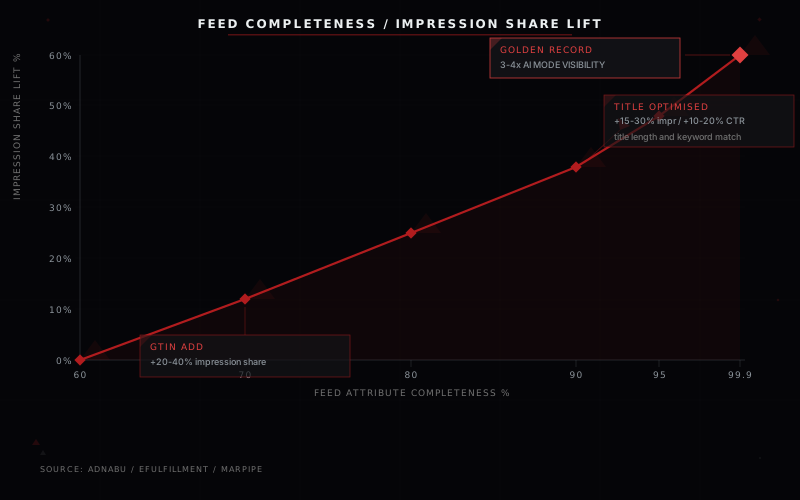
The most under-used title formula in 2026 is still Brand + Product Type + Key Features + Size or Color, kept under 150 characters. Optimized titles produce a 15 to 30 percent increase in impressions and a 10 to 20 percent CTR lift compared to vendor-default titles, according to feed-tool benchmarks aggregated by AdNabu and others. Stop using the manufacturer's marketing title. Write a title for the buyer who is searching, not for the brand sheet.
GTINs are the second-biggest feed lever. Products with correct GTINs see a 20 to 40 percent
performance bump compared to identical products missing them, because Google can match the listing to
its product knowledge graph and rank it inside richer surfaces. Aim for 90 percent or higher catalog
coverage. For handmade, custom, or generic items where a GTIN does not exist, set
identifier_exists = false on the feed to avoid disapprovals. Do not invent UPCs. The
fastest way to get an account suspended.
From June 2026, Google's Product Data Specification enforces a 500 by 500 pixel image minimum, with cleaner background guidance and tighter rules on variant images. Stores still using 250-pixel thumbnails will see disapprovals starting at the cutoff. Run a quick image audit now if you have not in the last twelve months.
The most under-discussed concept in 2026 is the Golden Record store, the term eFulfillment and feed-tool vendors are using for catalogs at 99.9 percent attribute completion. These stores are seeing three to four times higher visibility inside AI Overviews and AI Mode than catalogs at the 70 to 80 percent baseline. Feed completeness alone has been shown to expand impression share by 40 to 60 percent with no bid changes. The marginal cost of the last 10 percent of attributes is low. The marginal value is enormous because of how Google's generative shopping experiences pull from structured product data.
Mandatory attributes worth re-checking
The minimum required set: id, title, description,
link, image_link, price, availability,
condition, and either brand or gtin. Beyond the minimum, the
attributes that pay back hardest are color, size, material,
gender, age_group, product_type taxonomy mapped to Google's
taxonomy, shipping, shipping_weight, and structured custom labels for
margin, season, and inventory health that you use as PMax listing-group dimensions.
EU and Romania specifics
For EU and UK feeds, prices in the feed and on the landing page must include VAT.
The legacy tax attribute is deprecated for those regions. Embed VAT in the price
directly. For Romania, the standard VAT rate is 19 percent, with reduced rates of 9 percent and 5
percent on specific categories. Romanian-language feeds work natively for the Romanian market.
English-language feeds can also serve Romania via multi-country targeting if your product copy is
generic enough, which is a useful trick for cross-border DTC catalogs that do not want to maintain
parallel feeds. Producthero has a
good practical guide on multi-country Shopping
if you are setting up cross-border feeds for the first time.
One more European-specific consideration: feed price and landing-page price must match. Google's price matching enforcement tightened in 2026 and is one of the most common reasons accounts in Romania, Hungary, and Poland get listings disapproved. Build a daily verification check between the feed price and the live page price as part of your standard QA.
AI Max for Search: what to do before September
AI Max is the most consequential change in Search advertising since Smart Bidding. It pulls together three previously separate features. Search-term matching goes beyond exact, phrase, and broad to interpret intent across longer queries. Text customization generates headlines and descriptions tuned to the query, drawing on assets you provide. Final URL expansion sends the click to the most relevant page on your site rather than a fixed landing URL.
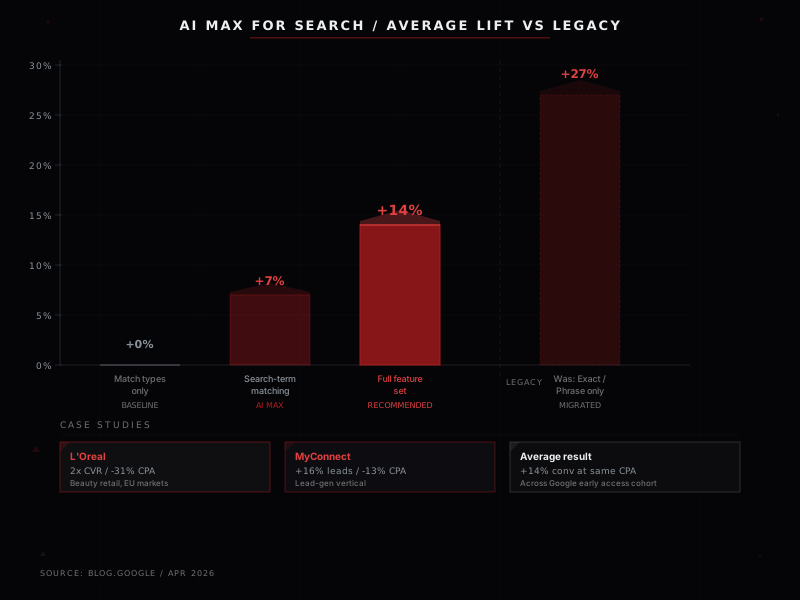
The Google reported numbers are real. L'Oreal saw a 2× higher conversion rate at 31 percent lower CPA. MyConnect saw 16 percent more leads and 13 percent lower CPA, with 30 percent of conversions coming from net-new queries the legacy keyword set did not match. The average advertiser sees plus 7 percent conversions or value over search-term matching alone, plus 14 percent over the legacy keyword-only baseline, and plus 27 percent for accounts that were previously dominated by exact and phrase match.
Three things to do before the September auto-upgrade.
One: audit your brand controls. AI Max can broaden into brand queries you do not want it touching. Use brand exclusions at the campaign level to redirect brand traffic to a dedicated brand campaign. Set up brand guidelines with up to 25 term exclusions and 40 messaging restrictions per campaign to control what the AI is allowed to write inside generated assets. The Google Ads Help page on brand suitability covers the mechanics.
Two: define your locations of interest. AI Max uses location signals more aggressively than legacy Search. If you sell only inside Romania, set Romania as the location and remove "people interested in" expansion to keep budget where it converts.
Three: stage the migration. Brand-defense campaigns first, because they are low-risk and let you observe AI Max behavior on a controlled query set. Then generic campaigns, where the conversion lift is biggest and the search-term reporting will surface new match opportunities. DSA replacements last, because the auto-upgrade in September will handle them anyway and you want to learn AI Max behavior on the higher-control campaign types first.
The account architecture we run for e-commerce clients
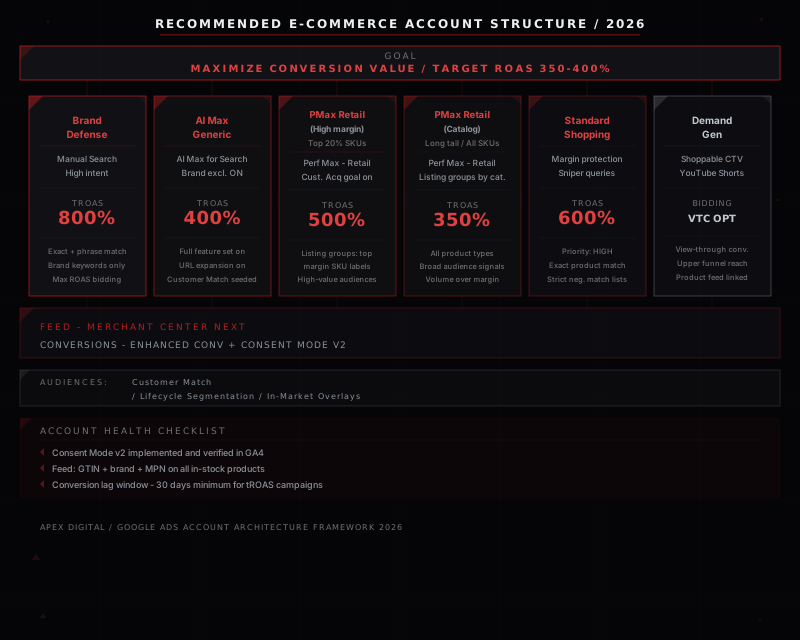
There is no universally correct Google Ads account structure. There is a structure that works for e-commerce stores between 50,000 and 2,000,000 euros in annual revenue, which is the bracket where most of our clients sit. This is what we run.
1. Brand Defense Search
A dedicated Search campaign on your brand terms with a high tROAS (often 800 percent or more) and tight match types. This is where you protect your most valuable query bucket from competitor conquesting. Use exact match plus a curated list of branded long-tail. AI Max is acceptable here once you have brand-suitability controls in place, but many accounts run this campaign on classic match types because the predictability is worth more than the small AI Max lift.
2. AI Max Generic Search
One or two AI Max campaigns covering generic non-branded queries with the brand campaign's terms excluded via campaign-level brand exclusions. Set Final URL expansion on, text customization on, and search-term matching on. Layer Customer Match audiences as audience signals, not targets. Run at tROAS aligned to your blended ecommerce target, typically 350 to 400 percent.
3. Performance Max Retail (high-margin tier)
A PMax retail-goal campaign scoped to your top 20 percent of SKUs by margin, using listing-group filters on the custom-label attributes you set in the feed. Enable the Customer Acquisition Goal with "Bid higher for new customers" so the algorithm pays a premium to reach net-new buyers. tROAS here can run higher than baseline because the margin tolerance is bigger, often 500 percent.
4. Performance Max Retail (catalog tier)
A second PMax retail campaign covering the rest of the catalog at a more conservative tROAS, often 350 percent, to protect blended margin while still scaling impression coverage across the long tail. The mistake we see most often on audits is a single PMax campaign that mixes high-margin and low-margin SKUs at the same tROAS target, which lets the algorithm overspend on low-margin volume. Splitting by margin tier inside PMax is the single highest-impact restructure we make on most accounts.
5. Standard Shopping (margin and sniper)
A High-priority Standard Shopping campaign overlaid on top of PMax for the SKUs and queries where you want manual bid control. Use this for clearance, seasonal liquidation, or specific competitor-versus queries where you want to defend at a price PMax averages cannot reach. Tinuiti's local inventory ads playbook is also worth reading if you have any physical-store presence, because LIA inside this same campaign structure can bring in-store buyers who would otherwise convert offline and disappear from your tracking.
6. Demand Gen
One Demand Gen campaign optimized for view-through conversions on YouTube and Shoppable CTV inventory. Layer creator-partnership content via YouTube Shorts where the format and audience match your brand. The April 2026 Demand Gen drop made VTC optimization a supported bidding input, which meaningfully improved Demand Gen profitability for accounts that were previously evaluating it on click-through conversions only.
What we deliberately do not run
Display Network campaigns outside PMax. They almost always underperform after fees, and the inventory they reach is now better served via PMax or Demand Gen. Discovery campaigns separately from Demand Gen, since Discovery has effectively been folded into Demand Gen. Search Partners on the Search Network unless we have proven incrementality, because the click quality is rarely worth the spend. For the full version of this architecture applied to your specific account, including a margin-tier breakdown of your catalog, our Google Ads e-commerce service handles the build-out end to end.
Measurement that actually survives 2026
Google's bidding and matching systems are only as good as the data you give them. In 2026, the measurement stack that actually survives privacy enforcement, browser changes, and platform consolidation is built on four layers: Enhanced Conversions, Consent Mode v2, Google Tag Gateway, and a clean GA4 attribution setup.
Enhanced Conversions
Enhanced Conversions sends hashed first-party data (email, phone, name, address) from your conversion page back to Google, where it is matched against logged-in user signals to recover conversions that the cookie-based default would lose. In June 2026, Google simplified Enhanced Conversions to a single on-off toggle, removing the method-selection screen for new accounts. Web and Leads are collapsing into one switch. Existing accounts with customer-data terms accepted are auto-migrated. This is now the default, not a power-user upgrade.
Consent Mode v2 (mandatory in the EU and Romania)
Consent Mode v2 has been mandatory since March 2024 for any site running Google ad products and targeting EEA users, including Romania. The 2026 reality is that Google is enforcing it. Accounts without Consent Mode v2 see policy compliance warnings and risk serving restrictions. Without it, you cannot do remarketing, conversion modeling, audience building, or Enhanced Conversions for EU traffic. The official Consent Mode v2 documentation covers the requirements.
Pair Consent Mode v2 with a Google-certified CMP. Pass both ad_storage and
analytics_storage consent signals from the same source of truth. Test the implementation
with Tag Assistant and verify that consent-revoked sessions still send modeled conversions, not
zero-data hits. If your CMP is sending only ad_storage and forgetting
analytics_storage, your GA4 data will silently drift away from Google Ads data and
attribution will start lying to you.
Google Tag Gateway and server-side tagging
Google Tag Gateway, formerly known as First-Party Mode, routes Google tag traffic through your first-party domain before relaying to Google. The setup guide shows it as a one-click toggle in Google Tag Manager. Cloudflare ships a native integration that handles the relay. Average data signal uplift after enabling Google Tag Gateway is 11 percent, with some accounts reporting a 10 to 15 percent conversion lift after enabling it because more conversion hits actually land.
Server-side GTM is the heavier-lift option. It moves the tagging from the browser to a server container running on your infrastructure, which gives you cleaner consent enforcement, fewer ad-blocker losses, and a place to scrub PII before it reaches third-party endpoints. The trade-off is operational complexity. Run sGTM if your monthly spend justifies a container on Cloud Run or Stape. Skip it if Google Tag Gateway gets you the recovery rate you need.
GA4 vs Google Ads attribution
Both platforms now default to data-driven attribution. They will not match. GA4 DDA evaluates the full multi-channel path including organic, direct, and social. Google Ads DDA evaluates only Google Ads touchpoints. The numbers will be different. That is normal, not a bug. Google's DDA documentation spells out the difference.
For paid-Google-only optimization decisions, trust Google Ads DDA and let Smart Bidding optimize against it. For multi-channel truth (Meta plus Google plus TikTok plus organic), use GA4 DDA or run a dedicated incrementality test or media-mix model. Aligning click-through windows across platforms is the single most overlooked step in cross-channel reporting, and it accounts for most of the "but the platforms disagree by 30 percent" complaints we field on audits.
Customer Match moves to Data Manager API
As of April 1, 2026, Customer Match uploads via OfflineUserDataJobService and UserDataService fail for developer tokens that do not already have Customer Match traffic. The replacement is the Data Manager API. If you upload customer lists via a third-party tool, confirm the tool has migrated. If you upload via Google Ads UI manually, this does not affect you. Customer Match is still the single most powerful audience signal you can give Smart Bidding, especially for PMax. Five hundred or more converters in the list dramatically shorten learning periods.
Bidding strategies and realistic ROAS targets
Smart Bidding in 2026 has consolidated to four core strategies: Maximize Conversions, Maximize Conversion Value, Target CPA, and Target ROAS. The strategy organisation guide treats Maximize Conversion Value with an optional tROAS guardrail as the value-first default. Use Maximize Conversion Value with tROAS as the standard for e-commerce. Use Target CPA only when you have a single conversion type with a stable economic value (lead gen, app installs).
Realistic ROAS targets
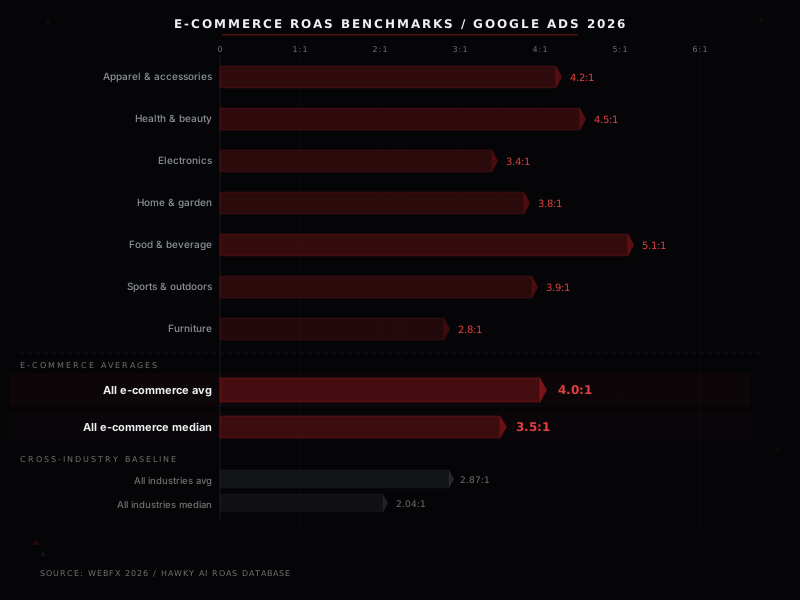
E-commerce ROAS on Google Ads averages 4.0 to 1 with a median of 3.5 to 1 in 2026, per WebFX's industry benchmarks. The cross-industry baseline including non-Google channels sits closer to 2.87 to 1 average and 2.04 to 1 median, which means half of all stores operate below 2 to 1. By vertical: health and beauty trends higher (around 4.5 to 1), food and beverage runs even higher when subscription models layer in (5.1 to 1 in the WebFX dataset), apparel sits near 4.2 to 1, and furniture runs lower (2.8 to 1) because of the longer purchase cycle and higher consideration cost.
When setting Target ROAS, stay within 20 to 30 percent of your current actual. Aggressive jumps cause delivery to throttle because the bid the algorithm can place no longer clears auctions. The fastest way to reduce your ROAS in practice is to aspirationally raise your target above what the market is willing to convert at. Deliver gradual, measured increases. If your current trailing-30 ROAS is 280 percent, set tROAS at 320 to 350 percent and let the algorithm catch up over two to three weeks before pushing higher.
Smart Bidding Exploration
Smart Bidding Exploration lets you set a primary tROAS plus a relaxed exploration floor. A common configuration: primary tROAS at 400 percent, exploration floor at 350 percent. The algorithm uses the headroom between the two to discover new audience pockets and query intents at slightly lower returns, then folds the winners into the primary delivery. This works best on campaigns that have at least three months of stable history and 50 or more conversions per month.
Campaign Total Budgets and seasonal control
Campaign Total Budgets, new in 2026, allow fixed total spend across windows of three to ninety days. Use them for flash sales, Black Friday, and seasonal pushes where the standard daily budget mechanics over-deliver early and under-deliver late. They also work well for finite stock liquidation campaigns where you want to cap exposure once the inventory is gone.
Romania, the EU, and the DMA reality
The Romanian e-commerce market is in the middle of a sustained build-out. According to Mordor Intelligence, the market reached approximately 7.98 billion dollars in 2025 and is projected to hit 11.65 billion by 2030, a compound annual growth rate of 7.81 percent. The GPeC reports for Central and Eastern Europe show online product spending in Romania climbing from 6.3 billion euros in 2022 to 7.0 billion in 2023 to 7.7 billion in 2024, with annual growth running above 10 percent. The market is concentrated: eMAG and Dante International dominate marketplace volume, with Altex, Flanco, Fashion Days, and Notino occupying significant verticals.
For a deeper look at the local agency market and what realistic pricing should be, our Romanian-language guide on choosing a PPC agency in Romania in 2026 walks through the 12-question scorecard we recommend.
The EU DMA and Comparison Shopping Services
The European Commission opened preliminary findings against Google Shopping under the Digital Markets Act in April 2026, with a final decision expected on July 27, 2026. The practical implication for e-commerce advertisers in Romania and across the EU is that Comparison Shopping Services can now advertise via their own product detail pages in both organic listings and PLAs. New SERP filters have appeared: "Product Sites" (CSS-only) and "Products" (advertisers plus CSS combined).
Working with a CSS partner can reduce Shopping CPCs by up to roughly 20 percent on EU-targeted campaigns. For Romanian retailers selling cross-border into Western Europe, partnering with a CSS is one of the cleanest ways to compress acquisition cost without changing campaign structure. The mechanics are simple: the CSS bills you a small percentage of media spend, Google credits a small discount on Shopping CPCs as part of its DMA compliance package, and the net effect is positive on most accounts.
VAT, feed, and language targeting
Romanian VAT (19 percent standard, with 9 and 5 percent reduced rates) must be embedded in feed
prices and on the landing page. The deprecated tax attribute is no longer the place
for it. Google's feed price-matching enforcement tightened in 2026 and the most common reason for
item disapprovals in CEE markets is a feed price that diverges from the live page by even one
decimal because of a stale cron job.
Romanian-language feeds work natively for Romania. English-language feeds can also serve Romanian buyers via multi-country targeting if the product copy is generic enough. For brands with a single unified catalog and limited resources to maintain Romanian translations, this is a practical shortcut that gets you in the auction without doubling feed-management overhead. We do recommend translating titles and descriptions for the top 100 SKUs by revenue at minimum, because Romanian- language listings outperform English ones on Romanian queries by a healthy margin.
The 20-point audit we run on every e-commerce account
This is the checklist a Google Partner-certified specialist runs on every new account before recommending changes. You can run it yourself in roughly two hours if you have admin access to the Google Ads, Merchant Center, GA4, and Tag Manager properties. Score each item zero or one and add them up. Anything below 14 points needs urgent attention.
Feed health (5 points)
- Catalog has fewer than 5 percent disapprovals or warnings in Merchant Center.
- Title formula on at least 80 percent of SKUs follows Brand + Type + Features + Size or Color.
- GTIN coverage at 90 percent or above (or
identifier_exists = falseset correctly for legitimate handmade or generic items). - All product images at 500 by 500 pixels or larger and free of overlay text or watermarks.
- Feed price matches landing page price for at least 99 percent of products on a daily check.
Conversion tracking (4 points)
- Enhanced Conversions enabled and verified at "Recording" status with no health warnings.
- Consent Mode v2 implemented with a Google-certified CMP, both
ad_storageandanalytics_storagesignals firing correctly. - Google Tag Gateway or server-side GTM in place, validated with a side-by-side conversion-count test against the prior baseline.
- GA4 e-commerce events (
view_item,add_to_cart,begin_checkout,purchase) firing with item-level data, no missingitem_idorpriceon key events.
Account structure (4 points)
- Brand and generic queries split into separate campaigns with brand exclusions on the generic side.
- Performance Max retail campaigns split by margin tier, not by category, with at least two campaigns covering high-margin and full-catalog tiers.
- Standard Shopping running in High priority alongside PMax for margin SKUs and clearance.
- Demand Gen present and optimized for view-through conversions, not legacy click-through goals.
Bidding and signals (4 points)
- Maximize Conversion Value with tROAS as the bidding strategy, target set within 20 to 30 percent of the trailing-30 actual.
- Customer Match audiences uploaded as audience signals on PMax and AI Max campaigns, refreshed at least monthly via Data Manager API or third-party tool.
- Customer Acquisition Goal enabled on retail PMax with "Bid higher for new customers" selected.
- Negative keyword lists active, scrubbing brand misspellings, irrelevant intent, and known waste queries; PMax negatives populated where appropriate.
AI Max and 2026 readiness (3 points)
- AI Max for Search enabled on at least one generic Search campaign with text customization and final URL expansion live, brand controls in place.
- Migration plan documented for any remaining DSA campaigns ahead of September 2026 auto-upgrade.
- Merchant API in use for feed delivery (or scheduled fetch / Sheets feed confirmed unaffected by August 2026 Content API cut-off).
We will audit your Google Ads account in 30 minutes. No charge.
A Google Partner with over a decade on the platform reviews your feed, conversion tracking, PMax structure, and the three biggest leaks. You leave with a one-page action plan whether you hire us or not.
Frequently asked questions
What ROAS should an e-commerce store target on Google Ads in 2026?
For most e-commerce verticals, an average of 4.0:1 and a median of 3.5:1 are realistic baselines on Google Ads in 2026. Health and beauty trends higher (4.5:1), apparel sits near 4.2:1, and furniture runs lower (2.8:1). The cross-industry baseline including non-Google channels is closer to 2.87:1 average and 2.04:1 median, which means half of all stores operate below 2:1. When setting Target ROAS, stay within 20 to 30 percent of your current actual or delivery will collapse. Aggressive jumps cause Smart Bidding to throttle volume because the bids it can place no longer clear auctions.
Performance Max or Standard Shopping in 2026: which should I use?
Both. The 2026 consensus from independent agencies is a hybrid setup. Performance Max handles scale across Search, Shopping, YouTube, Discover, Gmail, Display, and Maps and now accounts for 67 percent of Shopping spend and 68 percent of Shopping-attributed sales among advertisers running both. Standard Shopping handles margin protection, seasonal clearance, and sniper queries with priority bid stacking and granular negative keywords. Replacing one with the other is no longer the recommendation. Running them side by side, with clear roles, is.
Do I still need negative keywords in Performance Max?
Yes. Google raised the negative keyword limit in PMax from 100 to 10,000 per campaign in 2025, and account-level negatives are supported. Use that headroom to scrub brand misspellings, irrelevant intent, and known waste queries. Negatives apply only to Search and Shopping inventory inside PMax, not Display or YouTube. For Display and YouTube exclusions, rely on placement exclusions, topic exclusions, and brand suitability settings. Brand exclusions at the campaign level are now the cleaner way to redirect brand traffic to a dedicated brand campaign.
What happens to my Dynamic Search Ads campaigns?
They are being upgraded to AI Max for Search. AI Max went generally available on April 15, 2026. Manual upgrade prompts began in April. Automatic upgrades start in September 2026 and complete by end of September. After auto-upgrade begins, new DSA campaigns can no longer be created in Google Ads UI, Editor, or API. Audit your brand controls, locations of interest, and customer-list exclusions before September. Migrate brand campaigns first, then generic, then DSA replacements to keep performance baselined.
Is Consent Mode v2 actually mandatory in Romania and the EU?
Yes. Consent Mode v2 has been mandatory since March 2024 for any site running Google ad products
and targeting EEA users, which includes Romania. In 2026, accounts without Consent Mode v2 receive
policy compliance warnings and risk serving restrictions for EU-targeted campaigns. Without it you
lose remarketing, conversion modeling, audience building, and Enhanced Conversions for EU traffic.
Pair it with a Google-certified CMP and pass both ad_storage and
analytics_storage signals from the same source of truth.
How long until a new Google Ads e-commerce account is profitable?
Plan for two to four weeks of optimization and 60 to 90 days before performance stabilizes. Smart Bidding requires roughly 30 to 50 conversions per month per campaign to exit the learning phase reliably. Performance Max needs at least 30 conversions in the past 30 days at the campaign level for tROAS to function well. Brand campaigns turn positive almost immediately. Generic Search and PMax retail typically need a feed pass, conversion-tracking validation, and at least one full bidding-cycle reset before cost-per-acquisition lands inside target.
Are AI Overviews and AI Mode taking traffic from Shopping ads?
They are reshaping it, not killing it. Google AI Overviews now appear on roughly 14 percent of all shopping queries, a 5.6× increase in four months. Text and Shopping ads from existing Search, Shopping, and PMax campaigns are eligible to render inside AI Overviews and AI Mode, so an advertiser with a clean feed and a structured campaign is already in the auction. The bigger lever is feed completeness. Stores at 99.9 percent attribute completion see three to four times higher visibility inside generative shopping experiences. Our companion piece on making your website visible to AI covers the discovery layer in more depth.
Should small e-commerce stores hire a Google Partner agency or run ads themselves?
Below roughly 2,000 euros per month in ad spend, a careful in-house operator with time to learn can outperform an under-resourced agency. Above 2,000 euros, the cost of an account manager, a feed engineer, and a measurement specialist becomes worth it because the leakage from misconfigured PMax, broken conversion tracking, or missing Consent Mode v2 alone can exceed agency fees. Look for Google Partner status, named account ownership in writing, and reporting that includes spend, conversions, ROAS, and search-term audits. For pricing context, our guide on getting a fair quote applies to PPC services as much as to web development.
Google Ads is the most expensive line item in most e-commerce P&Ls and the place where mistakes hide longest. Ten plus years on the platform, Google Partner since 2020, EUR 100 million in client revenue moved. We do not sell magic. We sell a clean feed, a measurable account, a defensible ROAS, and the discipline to hold all three for 90 consecutive days. If that is what you want, we are the right call. If you want a 10× promise, we are not.
Google Ads is where mistakes hide longest. Let us find the leaks.
Google Partner since 2020. Over ten years running e-commerce accounts as if they were our own. Feed, tracking, structure, bidding, audited and rebuilt for 2026.